
Bolo de bolacha: the Portuguese cake that never sees an oven
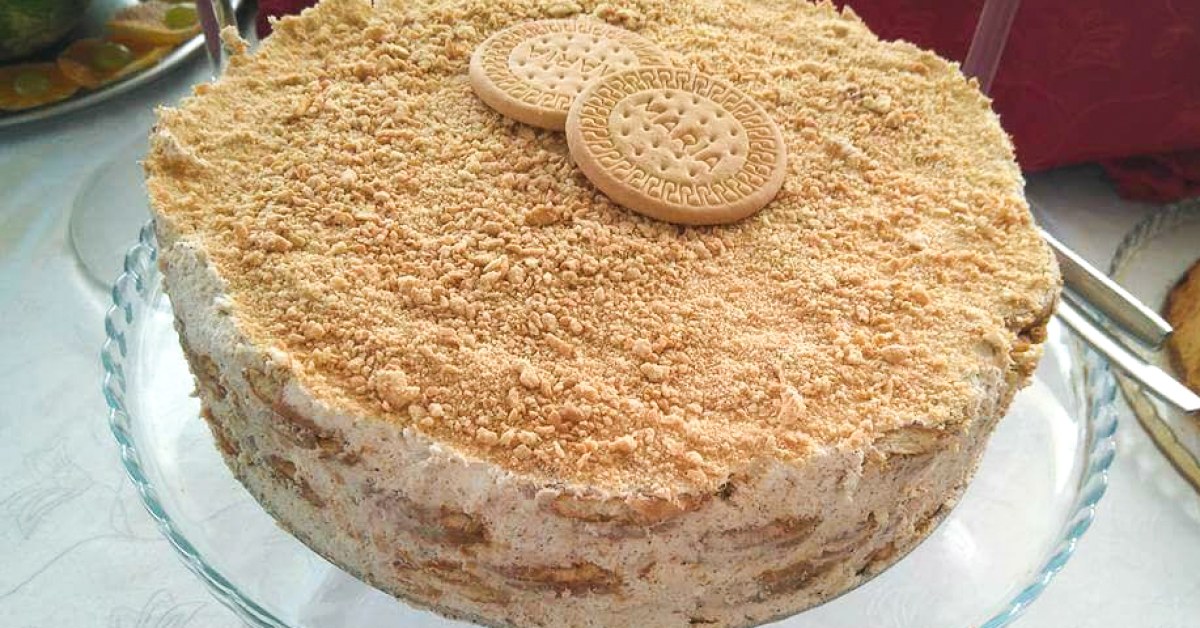
The blade goes in without resistance. No crust to break, no crumb flying off: the knife travels down in one movement and comes back striped brown and pale, the layers packed as tightly as the pages of a book dropped into a coffee cup. You do not cut bolo de bolacha the way you cut a cake, because it is not quite one. It has never seen the inside of an oven.
This is the dessert almost every Portuguese family knows how to make, and almost no shop window shows. Three things, no more: bolachas Maria (Maria biscuits), strong coffee, and a cream of butter and sugar. No baking, no spectacular technique. And yet the story of this thoroughly Portuguese cake begins in London.
A biscuit born for a royal wedding
The Maria biscuit is not Portuguese. It was created in 1874 by the London bakery Peek Freans, to mark the marriage of Grand Duchess Maria Alexandrovna of Russia to the Duke of Edinburgh. Hence the name, still embossed in the middle of the biscuit, a detail you will find today on packets in Lisbon, in Madrid and in Mumbai.
The design has never moved: a perfectly round disc, the name in raised letters, and all around it a finely worked border running along the edge. Inside there is almost nothing: wheat flour, sugar, a vegetable fat, a breath of vanilla. It is a dry, unassuming biscuit with no ambition of its own. Its great quality is that it drinks.
How an English biscuit became Iberian
The biscuit spread across Europe, but it found its true adopted homeland on the Iberian peninsula. In Spain, after the civil war, manufacturers produced it in enormous quantities to absorb a wheat surplus: the galleta María became a symbol of the country's economic recovery, a biscuit found everywhere because the flour had to go somewhere.
In Portugal, the story was quieter. The bolacha Maria took its place in the cupboard, next to the sugar and the coffee, and never left it. It costs almost nothing, it keeps for a long time, and it survives being handled by children. That is exactly the profile of a product people end up turning into something else.
Everything hangs on one second of coffee
The recipe fits in a sentence and still fails easily. You make strong coffee, let it cool, and dip the biscuits into it one by one. Then you stack: a layer of biscuits, a layer of butter whipped with sugar, biscuits again, cream again, until the dish is full. Smooth the top, cover it, and leave it in the fridge overnight.
The decisive gesture is the dipping. One second too long and the biscuit falls apart between your fingers before it reaches the dish; one second too short and it stays hard in the middle, with that small crack that gives away a cake made at the last minute. The biscuit has to drink enough to disappear, but not enough to collapse.
What the night in the fridge does cannot be seen. The moisture from the coffee migrates slowly from one layer to the next, the butter firms up again, and the borders dissolve: by morning there are no biscuits and no cream, there is a cake. It is the only cooking it will ever get — a cold one, done by time.
A cake you inherit, not one you buy
There is no single recipe for bolo de bolacha, but as many versions as there are kitchens. Some families add a splash of spirits to the coffee, others whip the cream with condensed milk, others finish with crushed biscuits or grated chocolate on top. Nobody has ever settled the question, and nobody wants to: this is the cake of children's birthdays, of Sunday tables, of the end of summer when switching the oven on feels like a punishment.
That absence of an oven also explains why you so rarely meet it in a pastelaria. Window pastry is built on what the home cook cannot do: massa folhada laminated by hand, doces conventuais built on dozens of egg yolks, custards that have to be stopped at the exact second. Bolo de bolacha can be made in any kitchen, with what is already there. It never needed professionals, and that may be precisely what saved it.
It shares that logic with another great no-bake classic of the Portuguese home, the salame de chocolate: the same biscuits broken by hand, the same chocolate, the same compulsory trip to the cold. Two desserts born of the cupboard rather than the bakehouse.
The coffee is not a detail
A good bolo de bolacha depends first of all on its coffee. Too weak and only sweet water is left; too bitter and the butter is flattened. The Portuguese do not have that problem: they have the bica, the short, concentrated coffee drunk standing at the counter, which once cooled gives exactly the right intensity. It is no accident that the cake and the country's coffee share the same geography: one was made for the other.
In Brussels, the gesture continues
At Wooly we do not sell bolo de bolacha: it is a cake that belongs to homes, and we would rather say so. Everything you need to attempt it, however, is a few streets away: real Portuguese coffee, bolachas unchanged for a century and a half, and something to compare it with in the chocolate salami on our counter. Our teams in Etterbeek, Stockel, Uccle and Waterloo will happily share their own version: each one swears hers is the right one, which is exactly the spirit of the cake.
Come by rue des Tongres in Etterbeek, or to one of our shops in Brussels and Waterloo: the conversation always starts with how many seconds to dip, and never really ends.
Photo: Eu Amo Portugal, Bolo de bolacha, CC BY-SA 4.0, via Wikimedia Commons.
Read next
Confeitaria Nacional: the Lisbon pastry shop open since 1829
At dusk, on the corner of Praça da Figueira, the red sign lights up before the street lamps do. Below it, a row of…
Dom Rodrigo: the Algarve sweet you unwrap like a candy
A rustle first. You pull at two corners of metallic paper, the golden ball appears, sticky, dusted with cinnamon. Dom…
Uvada: the harvest sweet they boiled at night, without sugar
There is no sugar in uvada. Not a gram. This Portuguese harvest sweet draws all of its sweetness from the grape itself,…
Tigelada: the dessert baked in the village bread oven, after the bread
The oven has just given up its bread. The vault is still glowing, the embers pushed to the back: that exact moment is…
Brisas do Lis: the Leiria cake that had to change its name
They were called the little kisses of the Lis, until the jokes at the counter forced Leiria to find another name. The…
Ceylon cinnamon: the bark the Portuguese found by accident
On a pastel de nata that is still warm, it comes last, in a gesture lasting one second. Yet this brown powder has…
Alfarroba: the Algarve's black gold, harvested with a long pole
In late August, in the hills behind the Algarve coast, you hear it long before you see anything: a dry, repeated…

Papos de anjo: the egg-yolk cake that is cooked twice
It leaves the oven baked, golden and domed — and yet the work is not finished. The papo de anjo goes straight into a…
Find our artisan pastries in our Brussels stores or order online.
Order now Our foodtruck for your events Our stores